Noah Libby-Haines

Teaching portfolio

Selected artifacts from full-time classroom teaching at ILA Vietnam and teacher preparation coursework at Moreland University. These pieces give insight into classroom practice, lesson design, assessment, and professional reflection.

Recorded lessons and supporting materials

Both lessons were recorded in my ILA Vietnam classroom as part of my Moreland University clinical practice, with a school mentor observing.

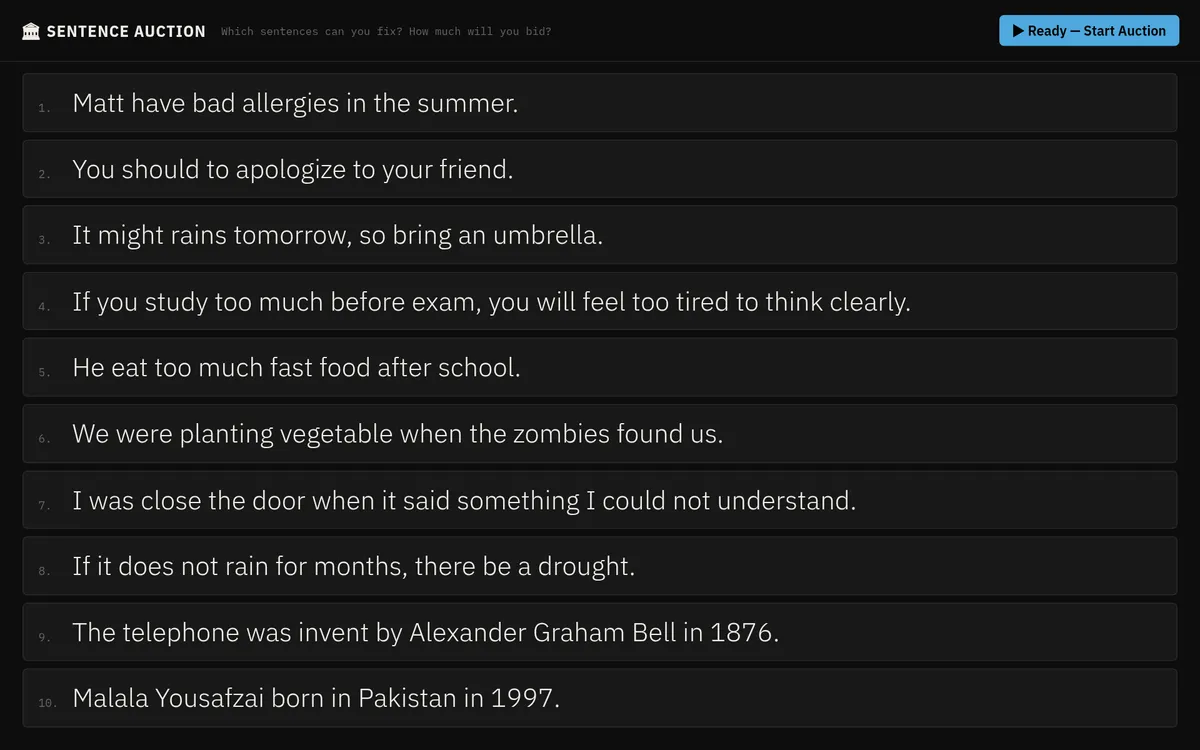
Custom Classroom Games: Language Learning Suite in Practice

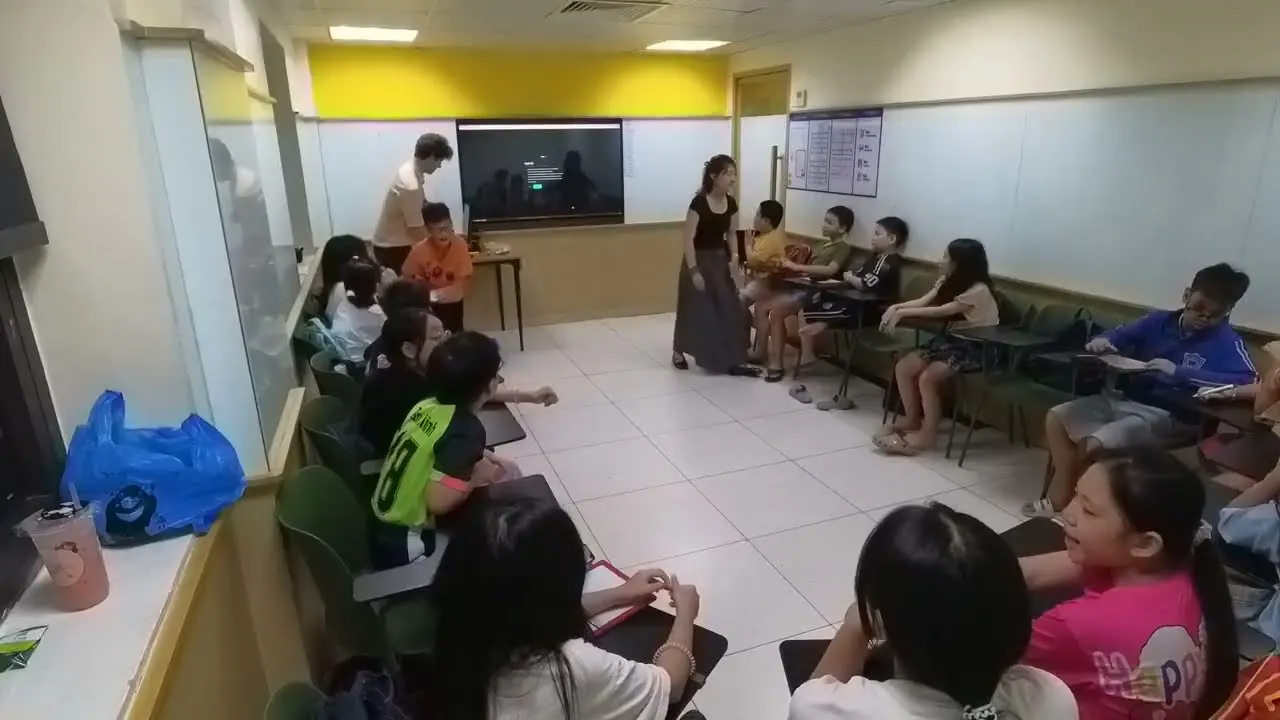
A recorded class at ILA Vietnam using the teacher-run game platform from the Language Learning Suite. The lesson uses custom vocabulary and grammar games for whole-class review: teacher facilitation, student team play, and real-time scoring.

Demonstrateslive classroom teaching, teacher presence and facilitation, whole-class participation, review and practice activity design, original classroom software in use

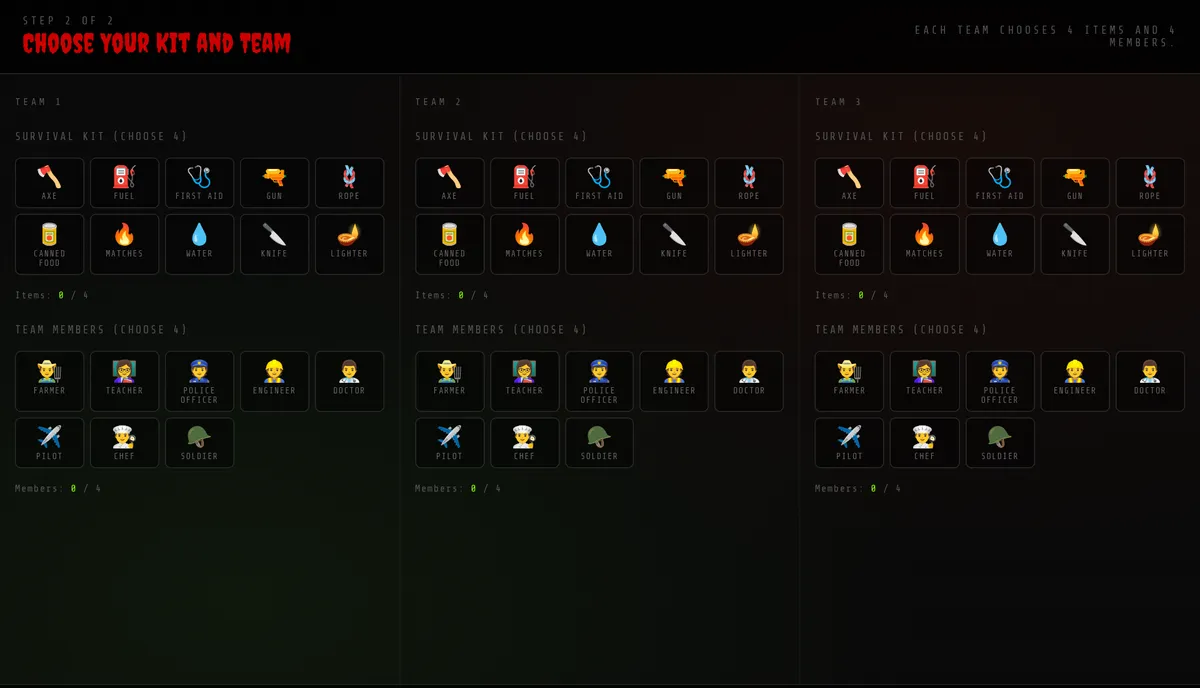
Zombie Survival Game: Reading Lesson, App, and Teaching Video

A recorded B1 reading lesson at ILA Vietnam using the Zombie Survival Game, a choose-your-own-adventure activity built for the class. Students worked through survival scenarios requiring close reading, vocabulary use, and group decision-making.

Demonstratesgame-based reading instruction, lesson planning and design, classroom facilitation, connecting a learning tool to a specific lesson outcome

Planning, assessment, and student support

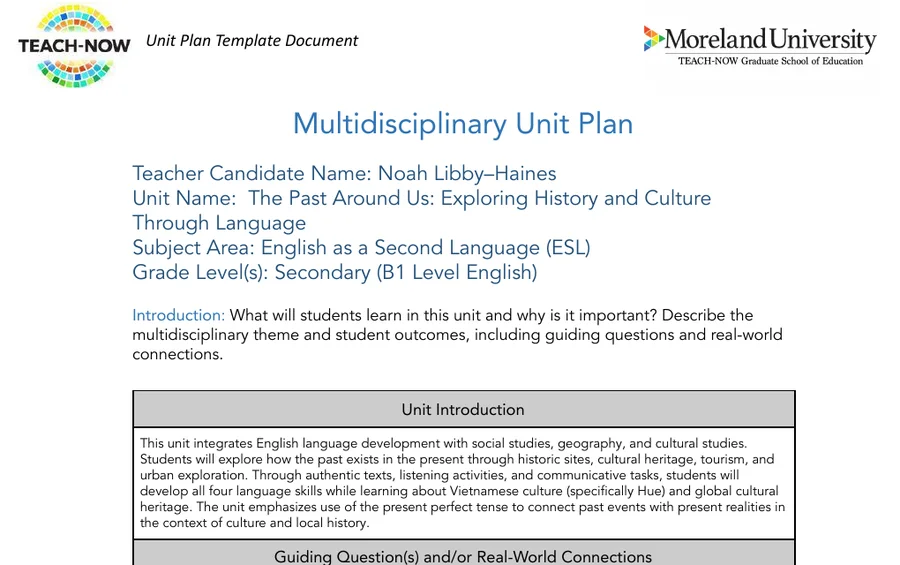
First page of the unit plan, The Past Around Us: Exploring History and Culture Through Language

Unit Plan: Multidisciplinary English Instruction

A complete unit plan for intermediate English learners at B1 level. The unit takes a multidisciplinary approach to language instruction, with structured lesson sequencing and clear learning objectives. Recognized by the course instructor as an exceptional example of unit-level curriculum planning.

Demonstratesunit-level planning and sequencing, curriculum design, multidisciplinary integration, B1 English instruction

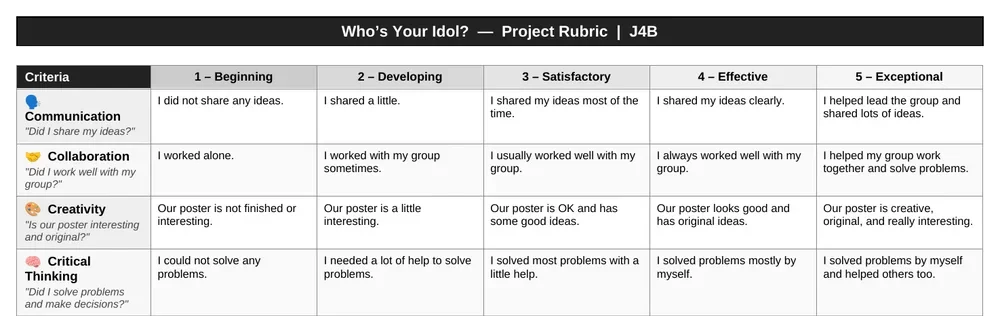
The Who's Your Idol? project rubric: six criteria, each with five levels from Beginning to Exceptional

"Who's Your Idol?" Project-Based Learning

A two-lesson PBL unit for A2-level students (ages 9–11) at ILA Vietnam. Students researched a person they admired, created a poster, wrote a presentation script, and delivered an oral presentation to the class. Assessment used a six-criterion analytic rubric; group scores ranged from 4.4 to 5.0 out of 5. The reflection covers what worked, two specific challenges encountered, and two proposed improvements for a future iteration.

Demonstratesproject-based learning design, analytic rubric creation, oral language development, student-centered instruction, formative and summative assessment, reflective practice

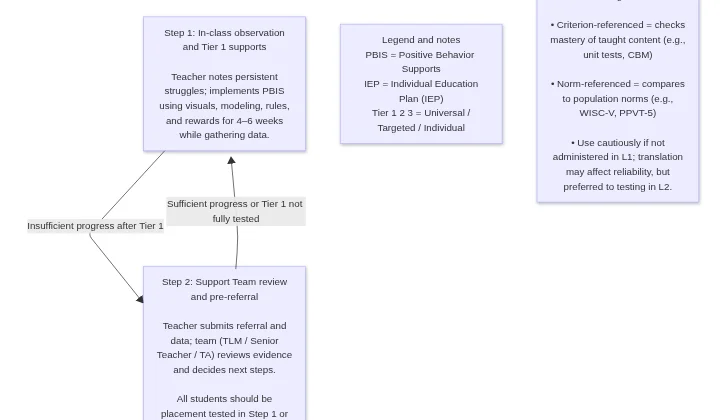
Part of the support flowchart: step 1, in-class observation and Tier 1 supports; step 2, support team review and pre-referral

Supporting Learners with Differences

A proposed procedure for identifying and supporting students with learning differences at ILA Vietnam, developed during Moreland coursework. The work centers on a process flowchart for recognizing and escalating student support needs within a language school context.

Demonstratessystems thinking about student support, differentiation planning, professional awareness of learner needs, practical planning for students with learning differences

Statistics lesson · Grade 9 Algebra 1

Striker Scout

A lesson on measures of center and spread, designed for a 75-minute class. Students must choose between two strikers who scored the same total. They find that the mean and median are identical, the mode only hints at a difference, and none of these measures describes how spread out the goals are. So they build mean absolute deviation (MAD) to measure it. Football and Free Fire data keep the statistics in contexts my students care about.

Developed in response to curriculum supplied by a school, demoed in an interview, and revised afterward.

Demonstratesstudents commit to a choice before seeing any statistics, then revisit it with evidence; frequent checks for understanding through simultaneous whiteboards, a prediction, independent MAD practice, and an exit slip; reasoning over procedure, including why range can fail and why MAD uses absolute deviations

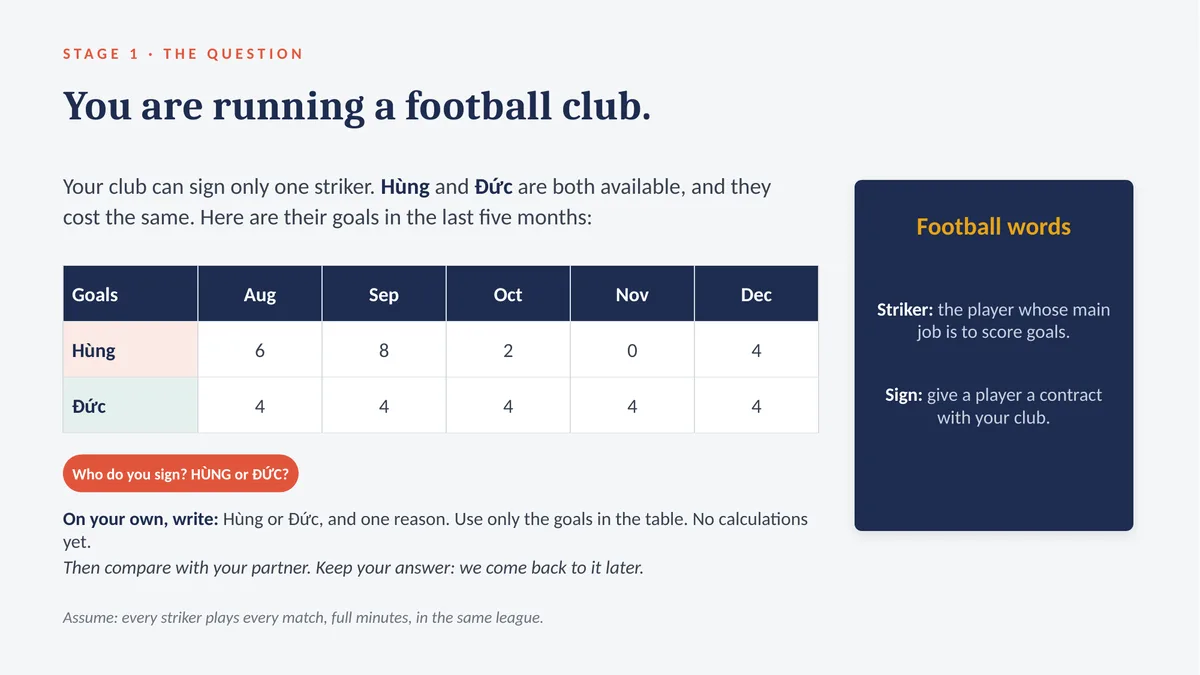
  • Slide: You are running a football club. Hùng and Đức both scored 20 goals in five months; each student writes who they would sign and why, before any statistics

    Commit first

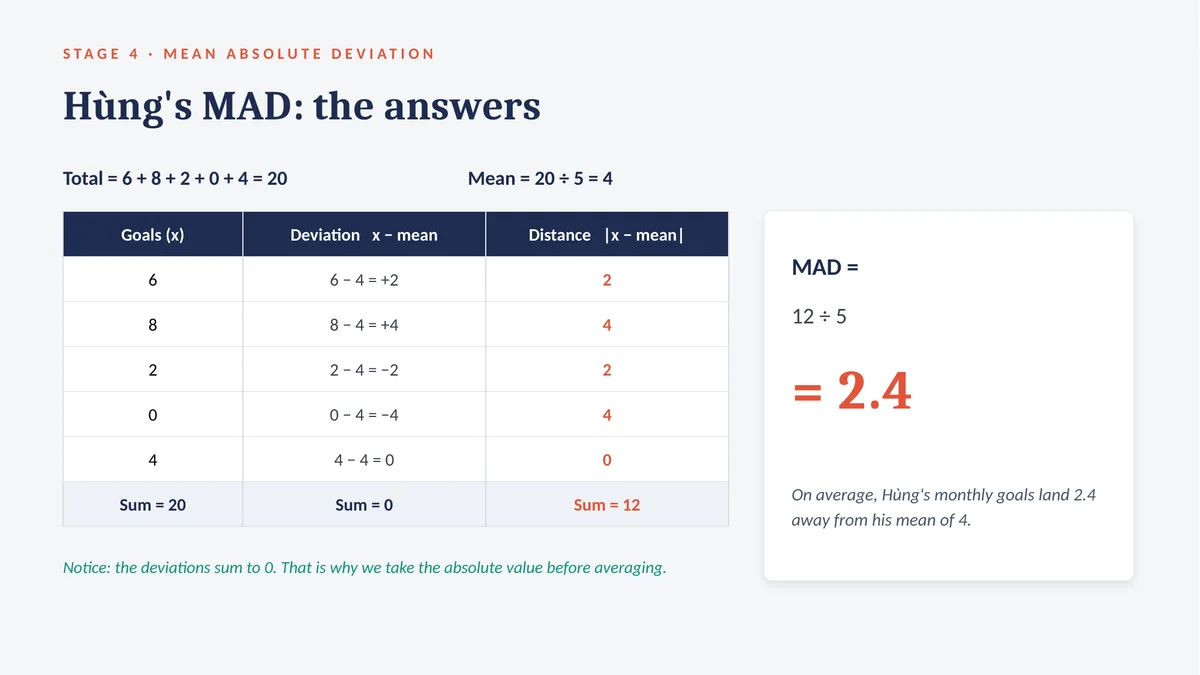
  • Slide: Hùng's MAD worked out in a deviation table; the deviations sum to 0 and the distances sum to 12, so MAD = 12 ÷ 5 = 2.4

    Worked MAD

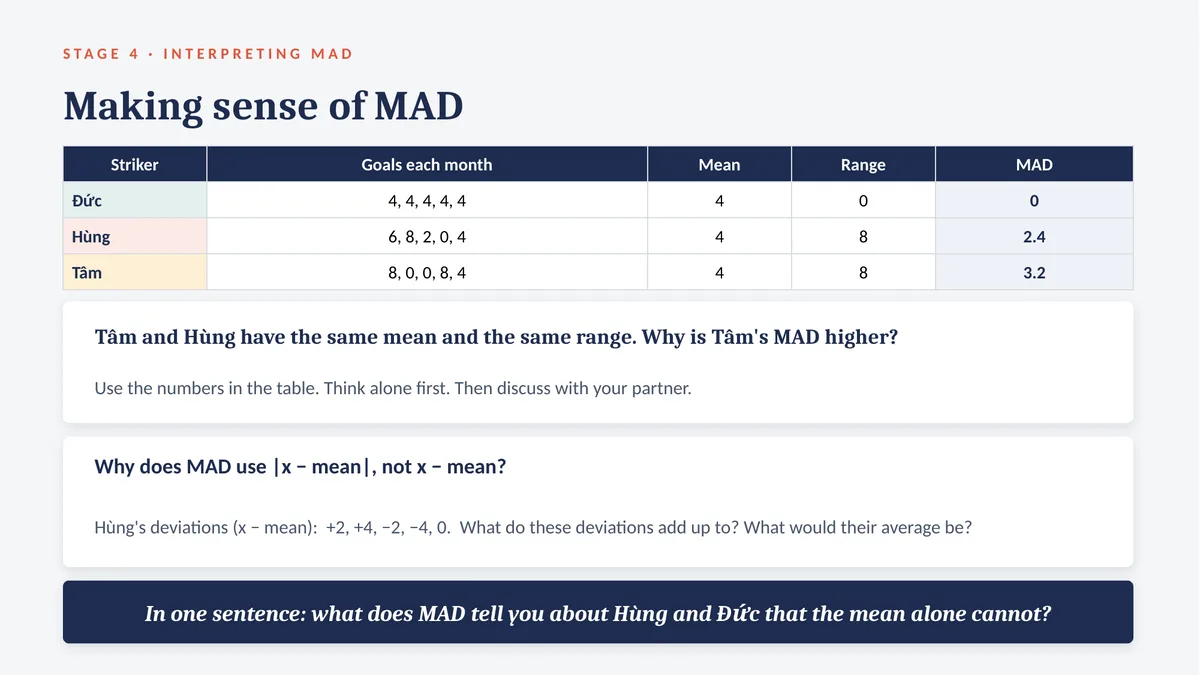
  • Slide: Making sense of MAD. Three strikers with the same mean; questions ask why Tâm's MAD is higher than Hùng's with the same range, and why MAD uses absolute deviations

    Reasoning check

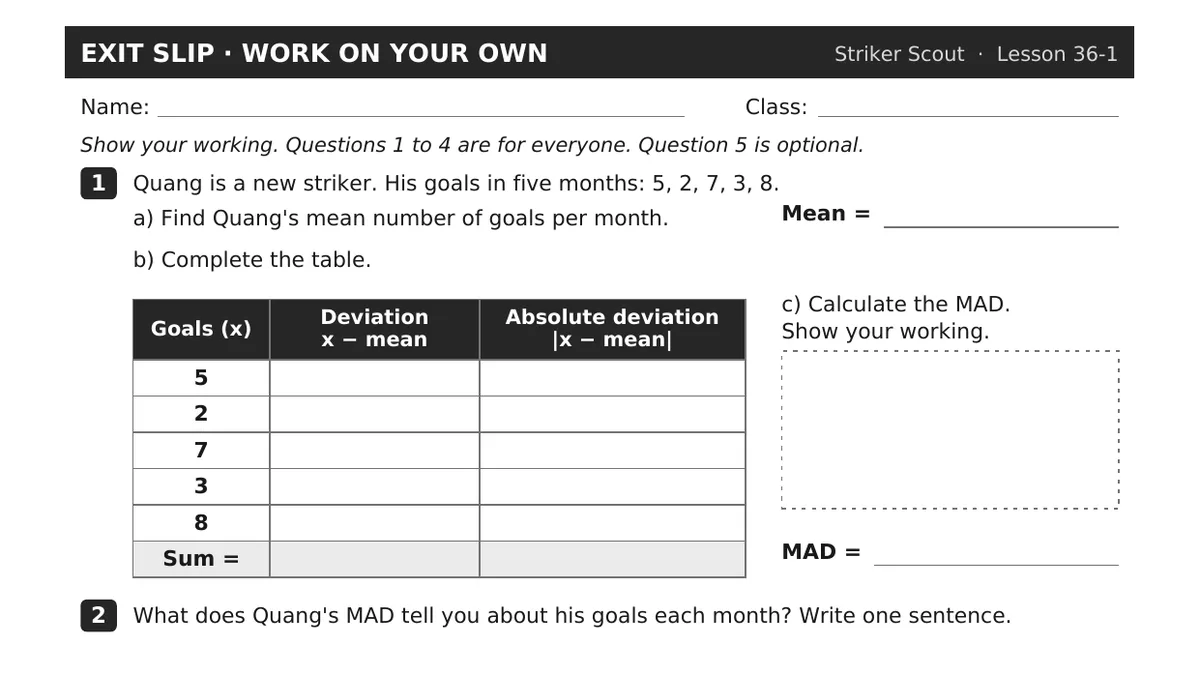
  • Top of the exit slip: question 1 asks students to find a new striker's mean and complete a deviation table to calculate his MAD

    Exit slip